1D - Tracer pulse during steady-state flow conditions
Problem Definition
This example describes the transport of a tracer under steady-state flow conditions in a one-dimensional profile. The aim is to verify the coupling of HYDRUS-1D and a given geochemical solver.
Acronym: ADR-T-SS
Geometry
The profile has a length of 100 cm and consists of a single material.
Processes and Equations
|
Water flow equation |
vertical flow (α=1), no water sink (S=0) |
|
|
Solute transport |
|
Initial and boundary conditions
The initial and boundary conditions are illustrated in Figure 1.
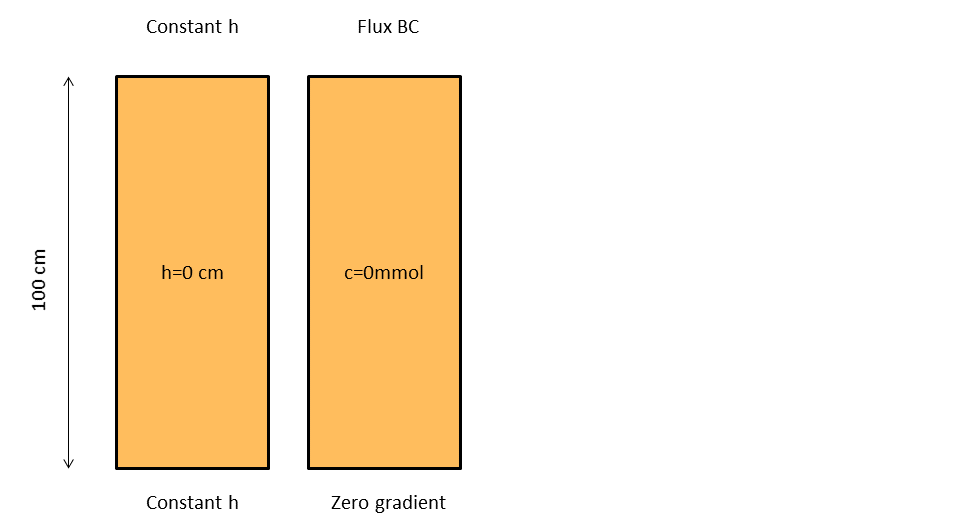
Figure 1 - Schematic representation of initial and boundary conditions for water flow (left) and solute transport (right)
The upper boundary condition for mass transport is a time-variable flux boundary condition with
c0 = 0.1 mol/kgw for 0 ≤ t ≤ 50d
c0 = 0.0 mol/kgw for 50 ≤ t ≤ 300d
Material Parameters
The hydraulic properties are described with the van Genuchten - Mualem model with m=1-1/n. Parameter values are in Table 1.
Table 1 - Parameters of the moisture retention curve and the unsaturated hydraulic conductivity as described with the model of van Genuchten -Mualem.
|
θs |
0.43 |
|
θr |
0.078 |
|
α |
0.036 /cm |
|
n |
1.56 |
|
Ks |
24.96 cm/days |
|
l |
0.5 |
The parameters of the solute transport equation and dispersion are given in Table 2.
Table 2 - Parameters of the solute transport equation (advection-dispersion equation)
|
DL |
8 cm |
|
Dw |
0 cm2/day |
|
τ |
Evaluation method
HPx simulations are compared with the calculations results of HYDRUS-1D. The output variables are:
- Time series of concentrations at depths of 3, 25, 50, 75 and 100 cm, and
- Concentration profiles at times 10, 20, 50, 100, 200 and 300 days.
Numerical Settings
The profile is discretized in 100 elements with 101 equally-spaced nodes.
The minimum and maximum time steps are 10-5 and 5 days, respectively (the latter being limited by the 0.5 day time step of output).
The Crank-Nicholson scheme for time weighting and the Galarkin finite element scheme for space weighting are used with a stability criterion (PeCr) equal to 2.
Results
Figure 2 shows an excellent agreement between the tracer breakthrough curves obtained with HP1 and HYDRUS-1D for the evolution to the tracer concentration at selected depths.
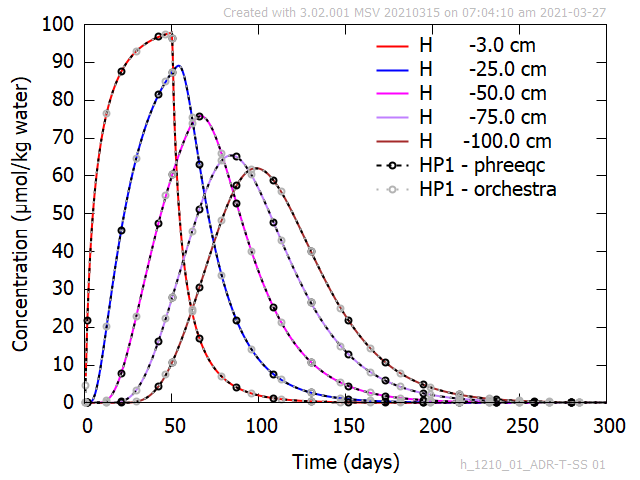
Figure 2 - Time series of tracer concentrations at selected depths during pulse application under steady-state flow conditions. Comparison between HPx and HYDRUS-1D.
Figure 3 shows an excellent agreement of tracer profiles at selected times obtained with HP1 and HYDRUS-1D.
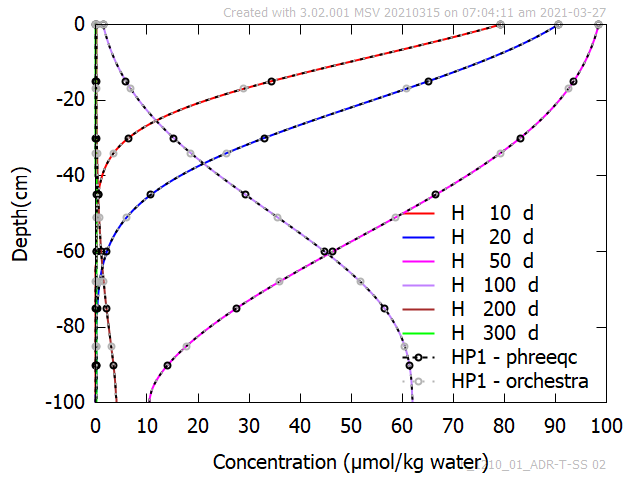
Figure 3 - Profiles of tracer concentrations at selected times during pulse application under steady-state flow conditions. Comparison between HPx and HYDRUS-1D.
HP1 Project