Gas Diffusion
In this tutorial, we explain how gas diffusion is included in a reactive transport problem.
The verification problem on gas influx into a profile without that gaseous component for no flow conditions. (see Verification -> HPx - 1D -> Gas Transport -> 1D - Boundary value problem during steady-state flow conditions).
The full project is available as GAS-SS-IN.zip.
We highlight here only the aspects that are important for diffusion of gaseous components in the gas phase.
HP1 Components and Database Pathway
For the definition of a reactive transport problem with diffusion in the gas phase and equilibrium between the gaseous and aqueous phase, one has to define not only the aqueous component, but also the gaseous component. For example, for diffusion of CO2, the transport of both the aqueous component C(4) (as defined in SOLUTION_MASTER_SPECIES) and the gaseous component CO2(g) (a phase name defined in PHASES) needs to be considered.
For the hypothetical gas in this example (Gc(g)), this means that both Gc (aqueous component) and Gc(g) need to be transported. The total number of components to be transported is 4 (Total_O, Total_H, Gc, Gc(g)) and are defined in the HP1 Components and Database Pathway dialogue window, as shown below.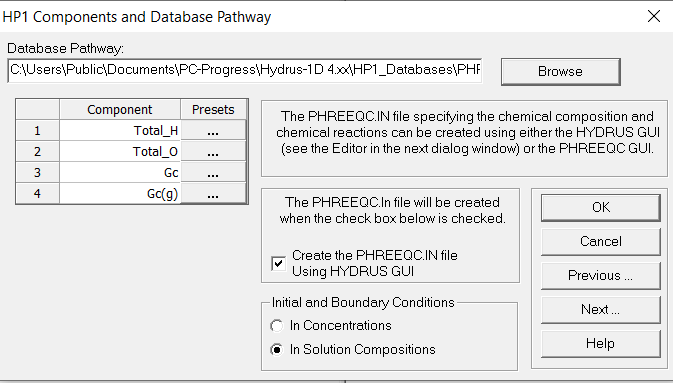
Additions to the Thermodynamic Database
Because a hypothetical gas component is used in the example, both the aqueous and gaseous component needs to define using SOLUTION_MASTER_SPECIES, SOLUTION_SPECIES, and PHASES.
|
SOLUTION_MASTER_SPECIES |
Definitions of Solutions Compositions
To define the partial pressure for the upper boundary (atmosphere), a gas_phase is defined. The number of the gas_phase will be used in the Solute Transport Boundary Condition dialogue window (see below).
The definition of the composition of the gas phase for a boundary condition is similar to the gas_phase definition in the PHREEQC manual with -boundary_layer as the only extra identifier. -boundary_layer is used to define the thickness of the stagnant boundary layer used for volatile (gaseous) components in HYDRUS (see HYDRUS manual). In this particular example, the thickness of the stagnant boundary layer is 1 cm.
|
SOLUTION 1001 initial condition mobile phase |
Geochemical model
To allow for diffusion in the gas phase, a data block gas_phase needs to be defined for each node. The most convenient way is define it for a range of nodes from node 1 to the last node using the system inline variable _NODES. If you change the discretization, there is no need to update the gas_phase block.
For gas_phase data blocks that are linked to the transport volume, the gas_phase should be defined as a fixed volume. When the transport simulation starts, the gas_phase is automatically set to -fixed_volume. The initial volume is calculated automatically from the water initial water content (defined in the HYDRUS graphical user interface) and the porosity.
|
gas_phase 1-@_NODES |
Transport Parameters
The transport parameters are defined in the Solute Transport - Transport Parameters dialogue window in table for the solute specific parameters. The first column is to define the aqueous diffusion coefficients for the aqueous components (and should be 0 for the gaseous components); the second column contains the gaseous diffusion coefficients for the gaseous components (and should be 0 for the aqueous components).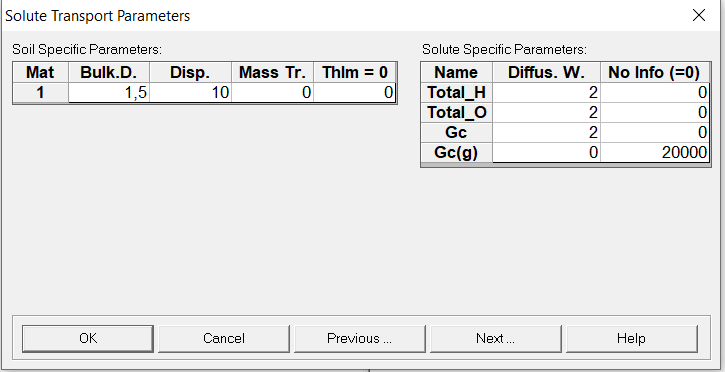
Note on advective gas transport
The coupled water and air movement is not included in HYDRUS/HPx, but the air flux can be approximated using the assumptions described in section 5.1 of the HYDRUS-1D manual [Simunek et al., 2018]. To activate this option in HPx, use the identifier stagnantgasphase in Reactive_transport.
Examples
Verification
Section Kinetic mineral dynamics
1D - Kinetic Mineral Dynamics - Acid Rock Drainage - pyrite oxidation