DUMP
Dump files are written when you select "Frequency by Print Times " in the "PHREEQC Dump" group box of the" HP1-Print and Punch Controls" dialogue window (Frequency by Print Times is the only option included so far).
When profile data is written, also a phreeqc.dmp file is created containing information on all chemical entities (solution, kinetics, exchange, equilibrium_phases, surface, solid_solutions). No thermodanamic data, rates, calculate_values, selected_output, user_punch, user_print etc. are written. These instructions should be repeated in the subsequent HP inputs (include$ can be used, see second example).
One important element is that you should include the phreeqc.dmp file in the "Geochemical Model" section of the Solute Transport - HP1 Definitions dialogue window. If you look in the phreeqc.in file, you see a section between your input from the "Definition of solution composition" and "Geochemical model" that is generated by the HYDRUS graphical user interface to correct the initial solution definition (e.g. solution 1001) to the water content. Because the amount of water is in the solution_raw block in phreeqc.dmp, including phreeqc.dmp before that section may cause errors.
Example 1 : ADC-E-SS-CEC
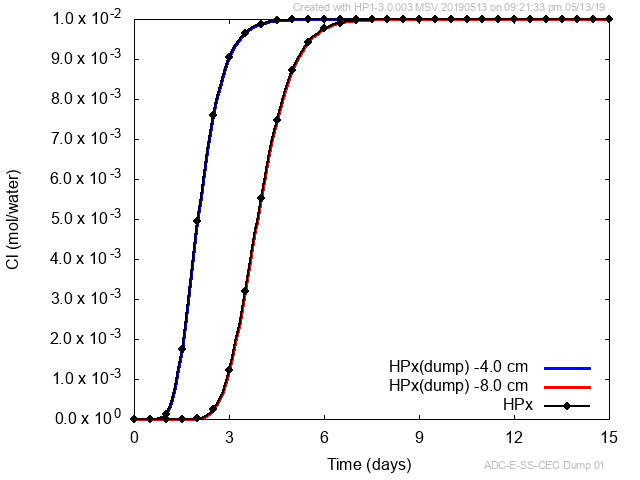
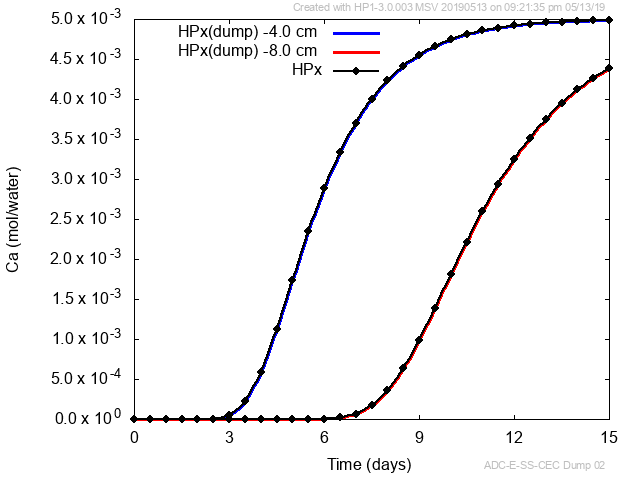
This is an example involving cation exchange (steady-state flow conditions) has a total simulation time is 15 days. In the dump example, the total time is split in 2 times 7.5 days.
For dump 2 (simulation between 7.5-15 days), we made following changes compared to dump 1 (except for time information):
Only a dummy solution 1001 needed in the extra section generated by the graphical user interface.
Include the phreeqc.dmp in HP1 - Geochemical model as a relative path to the current project (dump 2).
We obtained identical results in the 'dump' version compared to a single version
ADR-R-SS3
This example considers transport of three contaminants (Pola, Polb, Polc) with sequential degradation and nonlinear equilibrium sorption. Flow is steady-state but soil water contents equilibrates in the first few weeks.
It is an initial value problem with a contaminated layer. We split the 300 d simulation in 2 times 150 days.
The definition of the problem is somewhat complex as some recent features of HPx are included (inline variables, scripting, including files etc.). Because the thermodynamic and kinetic data is/should be identical for each 'dump'run, we save them in separate files and include this files in the gui. ADR-R-SS3-Thermo.txt and ADR-R-SS3-Output.txt are saved in the root file and included in the "Additions to thermodynamic database" and "Additional Output" sections, respectively:
Besides changes to time settings, we make following adaptations in the dump2:
- Only define dummy solution 1001 and 1002 in "definition of solution composition" (we have two layers, see Soil Profile - Summary dialogue window)
- Include phreeqc.dmp from dump1 in HP1 Geochemical model section
- Because the water content was transient during the 50 days, we also obtained the profile of pressure heads from nod_inf.out from dump1 (last profile) and pasted it into "Soil Profile - Summary" dialogue window. (In theory, you could produce the nod_inf.out as input for dump 2 via scripting; an example is not available yet).
Again, identical results are obtained.